

INTRODUCTION
What do most people do when they invest on the stock market?
They buy a share, which is often a stock tip they got around the water cooler at the office, ask their “trusted and inexperienced circle” if they should buy it, and then call their stock broker to take a punt.
The stock may go up, and very often it goes down. And when it goes down they then go back to their “advisers” who inevitably tell them to hold onto as it will recover soon. Often it goes down further, and they then hope it will go up again repeating the behaviour.
 The trouble is they have no strategy. They don’t know how to get into a trade and how to get out. They have no counter-strategy to defend their capital when they are losing, and they fall prey to the market makers in the game.
The stock owner often sees the stock market as a capital growth strategy. I began to view it differently when a smart accountant said to me that the stock market was about cash flow, and residential property was more about capital growth. I then viewed the share market differently.
Most who invest on the share market think buying stocks is the way to make money. They often believe that the one speculative share might make them rich, others are hungry for the dividend. However most don’t realise you can also make money on the market not only when it’s going up, but when it is also going down. The unprofessional traders entering the market, are generally the speculators who buy and hope.
When I first got into options I was intrigued when people said you could rent shares or insure them. These phrases were metaphors for calls and puts. Like most I had bought stocks. I’d lost more than I won, and did the “buy and hope” with no game plan. So when I heard there was another way, I was intrigued. I had to find out more.
Funny enough the first option I actually traded I did without really knowing what I was doing, and made a very big profit on it. It was beginner’s luck, much to the intrigue of my then accountant who always said what I was doing was dangerous. The truth is things are always dangerous when you don’t know what you are doing.
The reality is if you are serious about trading options you are starting a journey that is like starting a whole new career. You serve an apprenticeship, learn how the game is played, devise and define the strategy that suits you, systemise that strategy, and learn by trial and error. The most successful are those who have been mentored by someone who is successful at it. And this is what I received. I had the pleasure of being mentored by traders who consistently made returns every month. They taught me the right mindset, systemisation of trading, and the various strategies which are condensed in this course.
Additionally let me say options’ trading is not for everyone. It is a skill that must be learned, practiced, involves high discipline, and new responsibilities. It is not solely relying on advisors, but is taking responsibility for your own outcomes, understanding the “risk versus reward” dynamic.
Options’ trading requires emotional maturity.
Traders will make losses! If they haven’t they are liars, or only placed one trade in their lifetimes which was a winner.
However my mentor taught me, “If you can accept a loss, you will make a profit.”
What he meant was the way you handle a loss determines how you will bounce back to take advantage of a new opportunity in the market. Too many hang onto a losing trade hoping it will turn around. When you accept a loss you can move on.
 Psychologically you are now free to find a winning trade. You have been released from the pain of a loss and now the mind is open to profit.
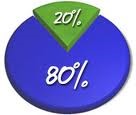
Mindset is key! Trading is about 80% mindset and 20% strategy. The trouble is most beginners want to rush to the strategy!
You must learn how to handle a losing trade, and what to do when it goes against you. This is where the real skill lies in trading.
So in the first part of this course I want to address the whole issue of what’s going on between the ears. For anyone starting on the options journey the goal is to become a successful trader who gets consistent results over time, not a get rich quick scheme!
Topic 1 – Life purpose & values, higher motivation, stewardship
Why do you want to trade? That is a key question for a trader. The reality is often you are up late at night or early morning, looking at charts and the market movements. It can be a rather lonely existence. For me it is the appeal that I can go to a computer in this day and age, place a trade on the other side of the world, and potentially make consistent cash flow by doing so. The internet has opened up a whole new world.
In fact in 2013 an article published by the Australian “Financial Review” stated that statistically Singapore followed by Australia were leading the world in people taking up online stock trading as compared to the UK and US. It is an ever expanding market.
The key is why do you want to trade, or more importantly why do you want to build wealth?
The answer to this will be very different for every individual, but needs to be defined to ensure a trader stays on track motivationally, when times get tough.
Ideally people who are motivated by a purpose greater than themselves are more likely to succeed, too. I love the example wealth educator John Demartini uses. He says if you knock on your neighbours door and ask for money and say the reason you need their loose change is you want to build wealth and you’ve come up a bit short this week; the likelihood of them giving to you is low. However if you tell the neighbour that after the death of a child on the road near the school you are raising funds to build a safer street, so that our children can get to the school safely; the likelihood of your motivation and the generosity of others increases exponentially.
You must have a cause greater than yourself!
Additionally I have found that you are often more likely to take better care of someone else’s wealth than your own. When I began to trade, my business partner wanted to put some money into the trading account and allow me to trade on his behalf.
 This in hindsight probably made me a better trader. I had the responsibility of not only handling my wealth, but was accountable to him for the results I’d achieve. If I lost funds I knew I’d have to answer for it. If it were just my wealth on the line, there would be less motivation.
The tradition of looking after other’s wealth is well ingrained in the financial industry. For example a trust fund has a trustee acting on its behalf. The trustee is responsible for managing the assets of the trust but doesn’t actually own anything. If needed, the trustee can be removed and another company or individual can be engaged.
How does this apply to wealth creation? Many teach about the accumulation of wealth. My perspective is that I am steward of the wealth that I have been given, accountable for it, and therefore must act responsibly with it. It frees me up to give more freely, be charitable, as well as to manage my investments wisely.
Topic 2 – Response vs Reactions
I mentioned that trading is about taking a new responsibility for the outcomes.
One of the most important keys that one of my mentors taught me is “THE MARKET IS NEVER WRONG!!!”
Too many traders blame the market for a losing trade. They point to fundamentals and what a stock should be. Let’s get a reality check for a moment. Theoretically a stock could be worth $40 but if it’s trading at $20 then that’s its value! The market is determining this, not the theory.
Additionally, too many traders blame the market when they are making losses. The problem is not the market. The problem is their strategy!
As a trader the key is to pull away from the emotion of the market, take responsibility for what they are doing, and think critically about how to assess and respond in the most appropriate way.
I’ve seen investors get worked up about certain regulatory bodies changing the rules just as they take on an investment. They then try to blame their advisor and in worse case scenarios threaten a law suit. A better use of their energy would be treating investing like a computer game. It should be fun, things will occur you didn’t plan especially if they are beyond your control. Try and resolve the issues and find solutions to the problems rather than fight them. When you get emotional about money – you lose!
I was once in a situation where a trade was going against me. I was managing margin carefully, only to receive an email from the broker that without warning they’d decided to increase the margin requirements for a particular stock I was trading. Rather than get mad, I had to just deal with it!
For me if I think of trading as a game, I’m more likely to trade with less emotional pressure.
 Mark Douglas put it well in his book “Trading in the Zone”. Trading is about going in with the expectation “anything can happen!”
When I place a trade I look at what I believe may occur, and where a safe place to profit from can be found. Once committed to the trade and the order is filled by the market I switch to “now anything can happen.” It’s a state of being aware of danger, but calm in terms of how I respond to it.
When an option trade is going your way I call it baby-sitting. It’s being present but keeping an eye on the activity of the market and what’s going on to ensure the thing is behaving itself.
When it goes against you that’s when you see how good a trader you are. What are you made of when you are tired, and need to hold your nerve? Can you make automatic decisions based on your strategy and process rather than yield to the fear of losing that can be screaming at you for attention?
I have a four stage response process that helps me assess the best response to a trade that is in trouble.
Here’s the difference. Rather than reacting, I respond! I have a very specific strategy that kicks in if I decide I need to defend my account. I have learned to make it automatic, keeping emotion at bay, holding my nerve and doing it as a matter of due course.
It’s often said people with military experience make good traders. They have learned to just obey orders and respond because if they don’t they, and their fellow comrades, could be dead. For them in the heat of battle, it is a matter of life or death and making automatic decisions is a must. Second guessing is what can kill you.
And as some business owners will tell you, sometimes making a decision even if it is the wrong one is better than sitting in the valley of indecision. A trader will inevitably face the moment where they must make a decision. Even if they decide that doing nothing at that moment is the best outcome, it is a decision. And this is what every good trader must be aware of! It keeps you sharp and on your toes! It is the art of responding and not reacting out of emotion. Be systematic not emotional. It is easier said than done, because the market is driven by two emotions – fear and greed!
As Warren Buffet puts it, “Get fearful when everyone is greedy. Get greedy when everyone is fearful.” While Buffet is more an accumulator in owning stock, it’s a good principle to be mindful of with the various market cycles.
Clearly he is saying do the opposite of what 95% of the population do. They follow the herd. Being aware of what the herd is doing is key. As an options trader where you place yourself in that trend is the key. You can make money with the market going up and down. It’s all about placement and a mathematical equation of probability.
Additionally it’s been said women are better traders than men. Some have said it’s because they are better at following rules. I believe a man’s testosterone to conquer things can get in the way. Trading is not about conquering the markets. Unless you are a big market maker you can’t control what the market will do. Instead you are like a surfer on a wave. You pick the wave that suits you. You set things up to catch the wave, testing, and measuring your trade; and once caught then you follow your procedure to ride the wave or the trade through. Just as a surfer balances themselves on a board, watching how the wave takes shape as it heads toward the shore, so a trader must catch the wave of an opportunity. If successfully “surfed” a graceful exit can be made. What you must avoid at all costs is a “Wipe out!”
Additionally when I’ve made a losing trade, rather than getting too down about it, I try to move on quickly. I know I can make it back and sometimes if a trade is going against me I know how to turn it around and make it a winner. It’s all about mindset. It’s all about a mature response to what is going on around you. It’s about staying in a balanced emotional state so if necessary you can remain creative in solving the problems.
Topic 3 – Goals, action plans and specific how
I love Mark Douglas’ affirmation. “I am a consistently successful trader!”
When starting I realised the key for me was to start with a small account size and learn the art of the trade. Take my eye off the money and focus on the art of the trade. I concluded if I could learn this, the money would follow. And as my mentor put it, “Always go for safety 1, 2 and 3!”
Remember that old saying, “Fail to plan, plan to fail”? The trouble is most don’t get round to it, and if we do, the plans aren’t specific enough.
Saying I will be a successful trader in the next 12 months is not specific enough in its planning. Saying, “I will in the next 12 months devote 5 hours a week to studying and paper trading to ensure I learn the rules of how options trade, define my strategy, and test it by virtual trading for another 6 months,” is far more likely to reap results than a general one.
I’ve seen some go even further. They define how much they will trade in their account, how much capital they will add if they are successful, how much cash flow they would like in 3, 4 and even up to 5 years. They are planning their growth. They are specific in their goals, and what naturally follows is defining the process on how they will get there.
Things may not always go according to plan. Just as a pilot must adjust their flight path if things come up due to changing weather conditions, delays in take-off due to technical difficulties, and unexpected turbulence. However, generally they arrive at the destination they defined in their flight planning. Constant adjustments are made along the way, with each of those bringing them closer to their destiny.
I’ve had to adjust my trading strategies a few times. In the beginning stages I arrived at a conclusion that one particular trade was safer than one I had paper traded for the previous year. Then when I began trading this new strategy it made great profits, but the markets then changed and I found a flaw. I ended up giving all my profits back to the market. After finding a patch, I traded a new strategy. Then the broker changed the rules on the margin requirements with the new strategy making it difficult to get the diversity in trades I needed. Finally I found an adjustment that satisfied all the requirements I was looking for. More protection on the downside, less brokerage held by the broker, allowing for the greater diversity I wanted!
I was tempted to throw in the towel, but persistence, focus, determination to find solutions, while remaining flexible to make adjustments led to successful solutions.
Correct mindset makes all the difference when taking up the art of options trading.