

Disclaimer: The following article is focused primarily on accounting and legal issues that relate to Australia. Having said this many of the general principles apply in other countries and jurisdictions. For specific and general advice you should seek an appropriate professional as the laws pertaining to taxation and law change constantly. Trading Institute is an educational company presenting factual information only. For investment advice, accounting, or legal advice, please see a licensed professional in the relevant area.
WHY PUT A TRADING PLAN IN PLACE?
It’s been said. “Fail to plan, plan to fail.” To increase the likelihood of any goals being fulfilled, whether they be personal or business, it is critical to be very intentional and specific.
 This is why many businesses have a business plan. A trading plan is very similar.
As you have gathered, the objective for a trader is to be able to set up their trading like a business.
This removes emotion from the equation when one trades, but also allows many traders to make expenses tax deductible that otherwise would not be so.
I’ve often been asked by traders, ‘Can I claim my educational expenses for trading as a tax deduction?’
Very often in the first instance it is not possible, especially if they have never traded before or don’t work in the financial industry. Educational expenses must be proven that they directly relate to how an individual derives their income; otherwise it is treated more as a hobby. So if someone who works in the financial industry needs to do a trading course in order to increase their ability to derive their income it may be claimable. If they have no association with the industry or any income generated from that activity then it is difficult to claim.
I often use the example of what if I were take a horticulture class to improve the roses in my back garden. This can’t be claimed as I am not in the business of horticulture, nor do I intend to be anytime soon. However, if I do a course in trading then yes it can be claimed as I am involved in trading to derive an income.
So for a client who wants to be in a position where they are in the business of trading they need to work towards setting themselves up this way.
In fact, when this occurs there are potentially a number of items that can be claimed for tax purposes. They include:
Data feeds
Brokerage
Ongoing education
Trade recommendation services and subscriptions
Any paid information that assists in trading
Educational seminars course fees
Travel expenses to travel seminars
Internet service provision
Computers (software & hardware)
Office expenses if a dedicated area is set up for trading. (Seek further advice from an accountant on this one, as conditions apply.)
WHAT DOES THE ATO LOOK FOR?
The ATO says it is important to know whether you are a trader or speculator. This makes a huge difference as to whether or not you can claim your expenses, and on the tax treatment of trading profits that you receive.
What they want to be able to see is gambling taken out of the equation. Gambling is associated with speculation.
 A business has a systemised behaviour that derives an income.
Suppose I had chickens in the backyard and I sold a few eggs to the neighbours. Would this be classed as a business or a hobby? It is most likely a hobby as the income derived from the sale of the eggs is not adequate to sustain me.
Conversely, if I decided to start putting in feeding machines, special incubation units, packaging machines, and pouring concrete to get trucks in and out, then it could be argued that I am running a business.
Not only are efforts being made to create a sustainable income, but a system of behaviour is forming by which an income can be derived.
WHAT NEEDS TO BE CONSIDERED?
Over the years I’ve coached many clients on how to set up their trading like a business. Two things assist in your trading being seen as a business:
- 1. A structure to trade through. The structure is recognised as a business entity.
- 2. A trading plan. This needs to demonstrate a well thought out plan of behaviour.
In the previous unit we looked at many types of business structures that can be considered.
This unit’s focus is on being able to demonstrate a pattern of behaviour.
I’d like to refer to one of the finest in the business when it comes to assisting traders to step up to this level.
Lawyer, accountant, former auditor with the ATO, CEO of Wealth Safe and Eternal Lawyers, Warren Black has designed a trading plan to assist traders in this endeavour.
He says, “The ATO has a number of criteria to look at in deciding whether or not you are carrying on business as a trader. These are:
- The size of trades
- The size of your trading account
- Frequency and repetition of your trading
- Whether you have a system to trade, or more gamble randomly
- Whether you have a written trading plan
- Whether you have a structure
- Whether you use software, subscribe to trading journals, level of self education, etc.
As a trader, you can claim all the expenses associated with your trading.
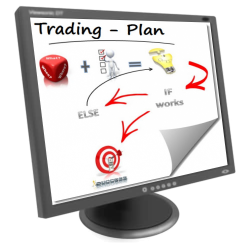 A trading plan is your blueprint to success. It should include your objectives, procedures, and most of all, your trading system. You follow it on a disciplined level for success, and also, it ensures that the ATO see you as a legitimate business.
A trading plan includes your entry and exit signals, your risk management, money management, whether or not you are day trading, medium term trading or long term investing, among other things. It should include your lifestyle goals from trading, the amount of money you want to make, the reason you are trading (income, fun or excitement), the amount of time you will spend, your ongoing self education plan, psychological training and maintenance, the amount of capital you wish to allocate to your trading plan, etc.
You want to be specific in your trading plan, and describe your entry and exit points in detail. Your trading will then become mechanical, cutting out emotions.”
Warren’s been kind enough to allow us to use his trading plan in this course. His companies, specialise in helping direct traders maximise their tax deductions. When following his trading plan he highlights 14 areas for a typical trading plan to follow:
- 1. Overview
- 2. Why I Want To Be A Trader
- 3. What Kind Of A Trader Am I?
- 4. “Know Thyself”
- 5. Paper Trading
- 6. What Are My Trading Goals?
- 7. Markets
- 8. Broker, Systems, Hardware and Software
- 9. Trading Strategy
- 10. Risk and Money Management
- 11. Education And Development
- 12. My Golden Rules Of Trading
- 13. Reference Material
- 14. Summary
As you can see many of the factors already discussed in this course leading up to this stage go into this trading plan.
Let’s look deeper into some further areas.
‘Know Thyself’ refers to the psychology of money. Here Warren is asking how risk adverse are you? What will trigger your emotions when it comes to the market? What measures will you put in place to protect your account? This includes not only defending but when making wins. How will you respond to wins? Will greed kick in?
I’ve known traders even put in personal rules that they will trade by. For example, some have said they will not trade when they’ve had a fight with their spouse. Others will not trade if they are over anxious about money at that time. My personal one is I will not trade actively in situations of personal sickness, a loss in the family, or a large personal life change.
These guidelines are all individualised. They will be vastly different for others. Each of us has different risk profiles, different trigger points, different strengths and weaknesses.
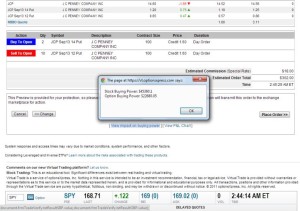 The Risk and Money Management’ area is a key area to define. I’d like to highlight the guidelines on allotting a certain percentage to any one trade. This can be applied to a multiple type of trade styles and may be more relevant to futures and FOREX trading. Having said this for options traders it can’t be dismissed and must be defined, especially if they are using margin.
Some traders have rules where they will never put more than 1% of their account on anyone trade. Some have to increase this to 5% due to their smaller account size and need “a bit more” capital to make the trade.
One of the guidelines I’ve seen for a successful options trader is only using 50% of their margin to the market at one time. He was a naked put trader. His reasoning was that if the market fell by 50% he would only lose in theory 25% of his capital in his account. Further, his trading guideline was that each trade he placed would never have greater than 50% of the margin at entry point. When using OptionsXpress brokerage he would measure the margin required by pushing the “View Impact on Buying Power” button on each trade. His goal was to have it near $500. This for him meant $500 for every $1,000 was being committed to the trade. The margin, of course, would fluctuate with market movements and requirements of the broker.
 Paper Trading as mentioned is practicing trading. It’s also sometimes called virtual trading. It’s like being in a simulator. Virtual trading should not be underestimated in its value. Whenever a trader takes on a new trade inevitably they want to know how it may play out if it goes against them. Virtual trading is the perfect platform to do this. Many brokers offer these tools to simulate trading conditions. While they may not have all the features of a “real money” trading platform they are excellent for training and practice. I’ve had to at times work out the practicality of which button does what on the brokers’ platform. Virtual trading has allowed me to “experiment” and “tinker” with no financial risk to myself. “Funds” can be easily added which can mirror a trader’s account size to suit their conditions. The benefits are that it is an incredible learning tool. They allow for testing a trade, from placement to locking in profit and defending, experimentation, familiarity with the platform, and analysis.
Additionally, virtual trading is not just a tool that’s used before someone ever begins to trade. It can be used by an experienced trader who wants to test a different strategy or a theory in order to discover something new. I wonder if it would have saved $65,000 for the traders we mentioned in our strategy course, who tested every trade they could discover!
Having said this virtual trading and simulation can only teach so much. Some traders say the difference between paper trading and live trading is emotion. Additionally, the fact that it is not real money means that some won’t treat the exercise seriously. They won’t monitor it as closely as they would if it were real. I’ve noted that traders who did take it seriously at their learning stage have greatly benefited from the experience when it comes to them finally taking the leap to trade live. They have been in simulation over numerous trades, and walked through the exercise of handling winning and losing trades. They have seen various market cycles, how things change, and how this affects the trade/s they’ve selected. I’ve seen it also help them decide which strategies they prefer and seen them test slight variations. I’ve also learned from their reports on how trades would have played out.
In my own journey, paper trading for a year helped me decide on which strategy I preferred. I practiced one particular one and then decided I didn’t want to do that anymore. I stumbled across what I believed to be a safer trade.
That experience gave me more confidence going into the markets. However, there was a lot of sweat on my brow when I first pushed the “Place Order” button on the live money trade.
“What Are My Trading Goals?” This area is about strategic planning, and we’ll explore this further in our last course unit. For now it’s asking, will the capital a trader uses when they first start trading be minimal? Then once things are proven, do they plan to add more capital? Will there be a third phase of growth once they’ve proven themselves at this new level?
What’s worth noting is some conditions may change as capital is increased. For instance, when a trader increases their account size they don’t have to be so concerned about the cost of brokerage fees eating into their profit. Additionally, a larger account allows for more diversification over the various stocks they may want to place.
While some traders may want to ‘graduate’ to these levels immediately to enjoy these benefits, what may be prudent is to stage this growth so a trader can adjust their ‘growth’ psychologically. It’s often viewed that if a trader has served their apprenticeship, adding a few zero’s to their account won’t be so difficult to adjust to with the experience and maturity they’ve gained in the earlier stages.
One of my personal mantras from the very beginning was ‘Learn the art of the trade. The money will follow.’ For a trader starting out the focus is too often on ‘making money’. Instead the focus should be on being a good trader and conducting your behaviour accordingly.
I remember the day that I stopped trying to be a good radio announcer and realised I was a good one. My psychology shifted. I relaxed more on air. My behaviour followed accordingly. I was now in a state of ‘being’.
So the benefits of doing a trading plan are many.
They help move a novice trader to a professional level. They assist in proving to the ATO that the trading is not speculation but indeed a proper business, and they help a trader define and refine what activity they are going to do. The trader may then be eligible for great tax breaks if they are considered as running a legitimate business.