

Every trader would love a crystal ball that tells them which trade will be successful and what the markets will do. I’ve always found it fascinating how weather forecasters can have so much credibility based on what they know but still be allowed so much grace for error. At best it’s always an educated guess.
There are so many factors in life that are out of our control. This is why once I’m committed to a trade my mindset is, ‘Anything can happen’.
One of the things that I have in my trading guidelines, as do many other traders, is avoiding trading a particular stock if there are 2 factors occurring:
- 1. A company announcement on earnings reports
- 2. Dividends pay outs
Additionally, I also take into consideration whether there is a holiday period pending.
 In my experience, these 3 factors can affect how a stock is traded.
What is a company announcement? It’s an event, update, or earnings report that a company may release to the exchange and public.
What is a dividend? A dividend is when a company schedules a payment to its stock holders to ‘share’ in the profits. It generally occurs when there is surplus cash which is not needed by the company, and it expected to pay out to its shareholders or even buy back some of its shares. Either scenario is generally a good prospect for a stock holder.
And while public holidays are obvious in terms of what they are, a trader needs to note them as they can affect market behaviour. If a trader is trading a foreign market becoming familiar with that countries market holidays is important in making wise decisions for trading.
Let’s get back to company announcement for a moment.
WHY ARE THEY IMPORTANT?
It’s very important for a trader to be aware of when these are scheduled. They can be a factor in how the stock is actually traded.
Options traders don’t always own the stock, and they may be trading the stock in particular directions. An announcement such as an earnings announcement often gets an emotional over-reaction by the market which can result in sudden buying or selling. An options trader doesn’t want to get caught out.
It can either work for a trader or against them.
Company announcements are important to be aware of as they MAY affect the price of a stock, and the market or traders COULD react to it if they perceive it will affect the performance of a particular company.
If news is positive, the stock and the future for the company may appear bright and the surge may be buoyant. People may buy quickly. Additionally, the opposite may occur if the news is negative.
 Earning reports and earnings seasons are typically times where the market reacts to news. I recently traded a stock, and it turned out that it was going to have to seek out further loans to survive, the board was fighting, the CEO was sacked, staff cuts were being discussed, and stores nationwide were going to be closed down. The stock went against me by over 60%. And while I did suffer some losses they were minimal as I was vigilant in defending. I fought hard. I fared far better than those holding onto the stock. Had I known all that was brewing within the company I would have been far more cautious on taking the trade. I may have traded to profit from it falling rather than rising.
I must quickly say here there are times where the market may respond to an announcement and there is just no logic in why the price is doing what it’s doing.
Sometimes there are reactions to company take overs. For instance, one stock will rise and the other will fall. Some traders perceive the cost as a bad thing in the immediate future; others think it is positive as a long term reaction. The bottom line is we don’t know. What you have to realise is sometimes emotion is illogical. The price of the share is the bottom line. It is what it is, and the reasoning surrounding that price may be logical or illogical. The impact on the options trader’s positions is the thing to consider.
Earnings announcements often cause reactionary trading. Sometimes rumours are being whispered about the company. The bottom line is whether good or bad the market MAY react in either direction.
Now there are traders who will trade options during these times and others who will avoid it.
I have had them go my way where it is positive and I’ve been able to close out a trade within a week of placing it. When they go against you though it can really sting!
Not all company announcements are a concern. Generally, with the strict regulations public companies are often required to report to the market. And as there is such a high volume of announcements being made much of it can be disregarded. Personally, I look at avoiding trading an option over a stock if it will fall in an earnings announcements period. I also look for anything extreme, and also check is there is a dividend payout scheduled?
It’s been noted that many stock traders like to buy a stock for a dividend payout. Everyone loves a bonus! It means they share in the profits and so the investment in the stock gets a tidy return if they are holding it during the payout period. Typically (but not always) traders will get the dividend bonus, and sometimes sell the stock once the payout has been received. Leading up to this time the trading on the stock may be bullish with the extra buy-ins wanting to receive the dividend. If I want to put an option on this stock I personally prefer to come in after the scheduled dividend has occurred.
When trading on public holidays I often look at what the holiday it is, its duration, and the general sentiment of that holiday period. I’m conscious leading up to Christmas it can be a positive time with the festivities. I am also conscious of any public holiday falling on the day of expiry and what that may do to an options expiry.
Finally, I am also noting that if I am selling options and there are a few public holidays over that time period, time decay on the option may go my way. This is especially a consideration for extended times over Easter, Christmas and New Year. The option has been sold over a few weeks and many of the trading days are shut down for holidays. Over Christmas and New Years liquidity can also be a concern if I need to close down a trade. Generally a lot of the big players stop trading the markets over this time; the volume of trades going through the exchange is greatly reduced. This needs to be considered on whether to trade at this time.
If trading internationally a trader should be familiar with when the markets will and won’t be open. These days may be different from the holidays within their own nation.
US options expire on the 3rd Friday of the month, but if the Friday is a holiday and the market is not open, then expiration is on the Thursday right before that Friday. This is something to note for Good Friday.
Day light savings is also a consideration. The market open and close times change. This will affect international time differences, and possibly the lifestyle of the trader. During the USA’s winter months the market opens later at night for traders in Australia. However, some Australian traders on the east coast prefer this as it means the market is still open later in the morning. They then trade the close. I personally find it harder to trade those months as I trade at night. A later start time means I’m up an hour later than normal before they will open.
SLIPPAGE & MARKET REACTIONS TO COMPANY ANNOUNCEMENTS
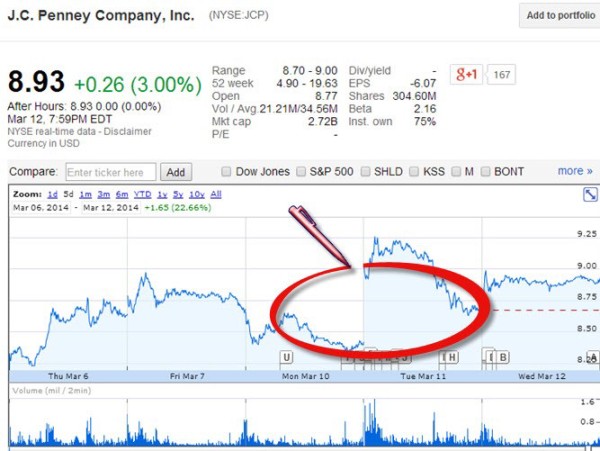
One of the big concerns for options traders is slippage. Slippage is when a stock takes a huge leap either up or down in price at the start of trading when compared to what it closed the previous day.
In the example below you can see the circled area where the stock slips between the Monday close price and the Tuesday morning open price. There is not a gentle rise but a gap.
This occurs for a number of reasons.
There is after hours trading called pre-market and post-market trading. Here a few traders engage in trading which can move the stock price. It is regarded in the industry as riskier trading than in the regular market, but it allows traders to respond to company announcements. The number of traders buying and selling at this time is limited, and liquidity can be an issue.
Sometimes companies will try to heighten or soften a company announcement depending on its nature.
So let’s say a company has positive news to announce. To boost its stock price it may select to release the information in the morning before open, to get the market enthusiastic about its stock. Suppose the pre-market traders hear of it, see it as a good thing, buy the stock and push the price up before open. The market may or may not follow the trend at open.
There’s now another consideration that plays a part in slippage that we need to recognise. Traders who are in the regular market may see what is occurring in the pre-market trading and place orders before the market opens. When this is done the orders are placed in a queue.
You can imagine when the market opens how there is a white wash of activity with pre-orders going through in addition to what the pre-market traders have done to the stock!
Now let’s assume a company has negative news. It may select to announce this at the end of the day rather than in the morning. It may want to “buy some time overnight”, so traders are less emotional about potentially selling the stock if the market was just opening. The post-market traders may trade the stock on this announcement pushing the price down after hours. In this instance the announcement could also have an effect to pre-market trading the next morning.
It’s very important to note those options traders who choose NOT to close out trades and let them expire worthless risk the post-market trading. Let’s say on the last day of expiry an after market trader decides to do a large sell off of the stock suddenly plunging the price. The trader’s out-of-money market options may now suddenly be in-the-money, even though it was an after-hours trade. The trouble is the options trader is locked out of the market and can’t close out the positions. They may be getting a notice from the broker on the Saturday that they have to have to come up with a large outlay of funds they did not foresee.
This is why I do two things when I trade. I personally avoid letting option liabilities expire worthless. I’m not concerned about bought options as sometimes it costs more in brokerage to close them out, but sold positions are tidied up with buy backs.
Secondly, if placing a trade I will often let the first hour of white wash, premarket orders and trades wash through, in an effort to discover what the stock will really trade for once all the orders have been cleared.
In summary, slippage can occur when company earnings announcements are made. They can very quickly put an options trader in trouble or in a place where they can profit early.
The reason they can profit early is intrinsic value can disappear rapidly on an option premium. Let’s suppose a stock has a pre-market gap from $20 to $25. An $18 sold put for the current month loses intrinsic value very quickly in this instance. It may be a time to lock in an early profit.
It really comes down to a personal decision for a trader if they choose to trade a company during announcements. This should be considered in their trading guidelines.
WHERE TO SOURCE COMPANY ANNOUNCEMENTS AND DIVEDEND PAYOUT SCHEDULES
There are a variety of free resources online to find out if and when a company has earnings reports due, a dividend payout, or a list of announcements.
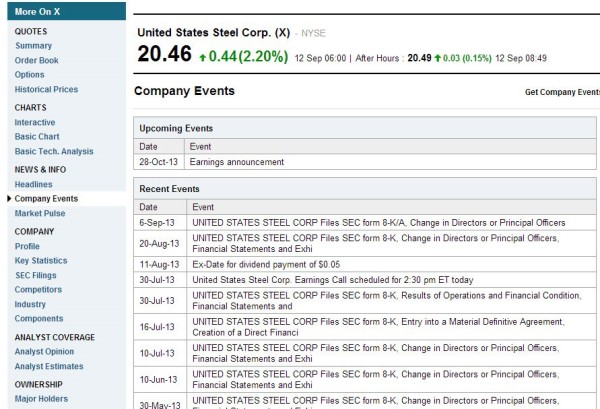
For the US market www.finance.yahoo.com is a great resource especially on company data. I also like the quick up to the minute feeds google offers, but dividends and schedules can be a bit harder to find www.google.com/finance
Below you can see the earnings announcement scheduled in the company events areas in finance.yahoo.com
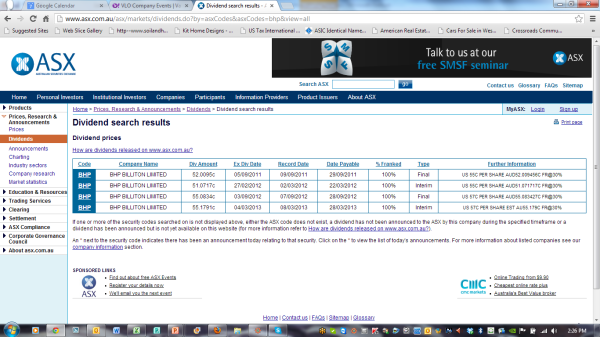
Dividend announcements on the ASX are also easy to find on their ASX website www.asx.com.au .
Adding this step into the “search for a trade” process is an important consideration for an options trader.