

 I remember attending a Serena Williams tennis match a few years ago where she annihilated one of her many “victims”. Serena is known for her strength, powerful ace serves, and her game face is always out for the kill. She makes the game look effortless which is always a sign of a true master.
What we haven’t seen is the countless hours of training, coaching, day to day niggling injuries in the early days that she and her sister Venus went through to get to the top.
Before you can even be competitive and strategize you have to learn how the game is played. What are its rules? What are the objectives? Then you can learn to strategize. Then you need to practice. And practice a lot!
Options trading is no different. When starting you have to know how the game is played in order for you to then formulate a strategy, test it, and then practise the strategy, before even placing a trade in the market.
The next part of this course is designed to teach you the rules of how the game is played. From there we will look at strategies.
CONTRACTS
Most people have some understanding of what shares are, but not on why they exist. Once you understand shares, it’s easier to see how options relate to them.
One of the ways people build wealth is by using other people’s money. It’s called leverage. When you are getting a bank loan for an investment you are using the banks money to hopefully build wealth. They agree to give you a loan and in return receive interest.
Similarly with shares, business owners often need to raise capital to fund their venture. Let’s say a business lands a contract to produce a million t-shirts but doesn’t have the right machines and factories to produce this. What they might do is sell a ‘share’ of the company so they can raise the initial capital to get the venture off the ground. The shareholders retain ownership of the company according to their holdings and also share in the profits of the business through growth in the share value; and in some cases receive regular payouts called dividends. This way everyone makes money that otherwise would not have been made due to a lack of capital.
When it is floated, a portion of the company is retained by its owners/board of directors and the remaining shares are bought and sold on a public exchange allowing public investors to participate easily.
There are 3 main players in the stock exchange – shareholders, the companies, the stockbrokers who facilitate trades and advise on the handing over of money, for which they earn commissions known as broker’s fees. (It could be argued there’s also a fourth party – the administrators and regulators of the stock exchange.)
So how do options work with shares? An option is a financial contract that is either bought or sold over a certain parcel of shares, at a certain price point, over a certain period of time.
 Standardized over-the-counter options commenced trading on April 26 1973 when the Chicago Board of Options Exchange (CBOE) allowed it over 16 various stocks. Prior to this you generally had to trade an option over the precise amount the stock was trading at. If it was trading at $25.34 for example you would have to write an options contract at that price point. Additionally, it was difficult to trade an option during the time it was relevant for whether it be 10 months plus 10 days, 105 days, 65 days or 35 days. It was a clunky system. The stock exchange went up and down within the day of trading and it was difficult to place a price on the option. It was difficult to find a buyer over an awkward price and time period. Generally an options investor had no other choice but to wait until the options expired. So, the Chicago Board of Trade (CBOT) put in fixed prices and fixed days of expiration on contracts.
When considering options, generally keep in mind there is always a seller and buyer engaged in a contract. With that in mind it’s worth repeating: Options are a financial contract to buy or sell a unit of shares over a certain stock at a particular price point during a particular time frame.
Let’s breakdown those words …
Option – An option for a buyer of an options is just that an “option” but not an obligation to buy. It gives leverage. For a seller it is an obligation if the stock price falls within the agreed strike price the contract outlines. If it falls outside of the agreed price the seller keeps the agreed premium.
Sell – Sell is often referred to as “write”. The reason is to sell a contract a trader used to actually have to physically write it out and then go and sell it to a buyer.
Contracts – Describes the obligation you are entering and also is a word that refers to the unit of shares it is written over. So when you write a contract you do so in a standardise number of units.
The US market is traded in contracts of 100 units. One option contract is the equivalent of 100 shares. The Australian Stock Exchange (ASX) traditionally trades contracts in units of 1,000. In recent times it also opened trading to contract unit sizes of 100. So currently the ASX does both, and it’s important a trader of this market knows the exact contract size they are dealing with.
Obviously there are multiple markets in the world, and it is critical you understand what the obligations and nuances of each if you decide to trade them, as it will have a huge impact on your financial position if you are caught out simply because of ignorance. For a very basic overview of many of the world’s exchanges you can find out more at this link … http://en.wikipedia.org/wiki/Option_(finance)
For simplicity and for our fellow Australian citizens who may wonder why our focus is on the US market over the Australian market, here is why …
The US market is the biggest economy in the world, while Australia’s economy is less than 2% of the world’s wealth. So when America “sneezes the world catches a cold!” By the US market’s sheer size there are a lot more people to trade with, and that volume allows more possible trades.
Secondly, the US market significantly exceeds the number of companies who allow options to be traded over them than the Australian exchange does. This gives a trader far more choice. The Australian exchange is limited to just over a dozen companies. The US is well into the hundreds when it comes to potential stock and trades.
Thirdly, with the difference in contract size there is traditionally less risk in the US option market compared to the Australian. Say a stock is valued at $30. One contract of a $30 stock on the US exchange is valued at $3,000, compared to the Australian tradition where 1 contract is valued at $30,000. There’s a lot more money on the line at that level which really only allows opportunity for big company investors.
Strike – refers to a price point of a share price. They are often done in 0.50c, $1 and even $2.50 increments in shares costing between $5 – $25. From $25 – $200 they generally run in $5 increments, and for stocks over $200 they often fall in $10 increments. (Always check on the increments for a stock as there can be variances.)
Expiration – is the time frame an option contract will be considered worthless or redeemable depending on the underlying stock price and the contract strike points agreed upon. In the US market options expire on the 3rd Friday of the month. If the Friday is a market holiday expiry falls on the Thursday before the 3rd Friday. ASX options expire on the Thursday before the last business Friday in the month.
CALLS & PUTS
There are a few reasons why people trade options. Let’s focus on the buyers for now. Those who primarily buy options do so for leverage or protection. When it comes to leverage, generally they want to control a great amount of shares with minimal outlay.
For example, Belinda believes that the stock price of ABC shares of $4 will go up to $5 or beyond in the next month. To minimise her risk she may buy a $1 option over 1 contract (100 shares) to give her the option to buy those shares at $5 each for just $1 outlay provided they reach that strike price or beyond.
So Belinda will pay $1 for 1 contract ($1 x 100 shares) = $100 to potentially take possession of shares valued at $500 or beyond. This is known as buying a CALL OPTION contract, or put simply “bought a call.”
 A bought CALL option is the right to BUY shares at a certain price.
Let’s say Belinda’s call option went really well. At the end of the month ABC shares actually went to $6. Belinda made a $100 profit on top of her option contract! Now she wants to insure her shares at $5 so that if they fall below that price in the next month she will be able to guarantee that her initial profit is protected.
A PUT option is the right to SELL shares at a certain price.
 Belinda buys a ‘put’ option for $1. This allows her to “put” (sell) the shares to whoever wrote her the contract for the reminder of the month which helps her sleep better at night knowing her shares are protected should they go down in value.
It costs her $1 per her 1 contract (100 shares), and her total expense to insure her position is $100 for the month.
Those selling options do so for the cash flow on the premium they receive when they sell the contract. Additionally, those who sell options may also buy options at the same time to protect their sold positions to reduce liability. We’ll discuss this further when we get into strategy.
OTHER OPTIONS ANOMOLIES
Bid & Ask
The bid price is what the option seller can sell their contract for, in order to be filled. The ask price is what an option buyer pays, in order for their contract to be filled.
Sometimes when writing options you may chose a price in between the ask and bid price to be filled. This can help get a bit more for the contract as well as ensuring you get filled.
Additionally the bid and ask prices will fluctuate as the stock price moves. This takes into consideration the intrinsic and time values of the option.
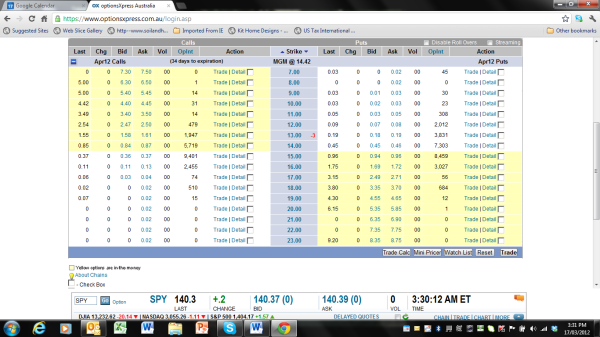
Bid & Ask chart for calls and puts
Out of the money, At the money, In the money
A contract position is referred to as either:
‘Out-of-the-money’, ‘At-the-money’, or ‘In-the-money’.
Let’s look at each of these in turn …
Out-of-the-Money – This refers to a contract position that’s outside the value of the strike price.
Eg Belinda bought her Call option at a strike price of $5 when the stock was trading at $4. She bought an ‘out-of-the-money’ position because the stock was not at that strike price.
At-the-Money – This refers to a contract being at the same price as the strike price.
Eg If Belinda had bought a call option at $4 when the stock was the same price we would call this buying a contract ‘at-the-money’. She would have also had to pay a higher premium than $1 for this privilege, because the probability of the stock going upwards is greater than buying out-of-the-money at $5. It is also more risk for the person who sold her the contract and so they would charge more for this option.
In-the-Money – This refers to a contract being written inside the value of the strike price.
e.g. If Belinda had bought a call options at $3 when the stock was $4 she would have bought a contract that was already ‘in-the-money’ or already profitable. However, she would have paid a much higher premium for this as the probability of the stock being profitable at this point is far greater.
Intrinsic & Time Value
Prices on option contracts do fluctuate due to stock prices, market sentiment and intrinsic and time value.
Intrinsic value is the value on an option in terms of its value to the stock price, and whether it is ‘in- the-money’, ‘at-the-money’, or ‘out-of-the-money’.
Again let’s look at each in turn …
An ‘in-the-money’ option contract is the most valuable when compared to ‘at-the-money’ or ‘out-of- the-money’. It means that an exchange of the underlying stock will take place as the agreed price between the option writer and buyer, should it stay at this price when the contract expires. This is great for an option buyer but potentially dangerous for an option seller.
An ‘at-the-money’ option contract is trading at the same price as the underlying stock but is not as strong as an ‘in-the-money’ contract. The stock will not be exchanged if the price doesn’t move from ‘at-the-money’.
E.g. A stock is trading at $20.05 and the option is agreed at the strike price at $20.00.The stock to change has to be either at the agreed price or ‘in-the-money’.
An ‘out-of-the money option’ value is less than any of the above positions. Generally these are where options are initially bought or sold at the start of the contract. For the buyer of the contract the prices are lower and for the seller of the contract while there is less premium, there is less risk with their obligations.
Time value – Time value is measured on the length of the contract. The longer that contract has to expiry the more value it has. However, this changes as the time to expiry draws closer.
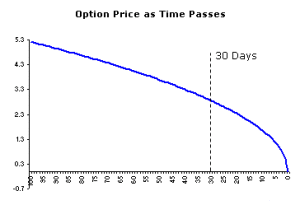 Time Decay
We also know that typically an option premium that remains ‘out-of-the-money’ loses its value over time. The first two thirds of its life it loses 33% of its value. Naturally the closer it edges towards expiry the more value it loses. In fact in the last two thirds of its life it loses 66% of its value. The final two weeks of an options life span sees incredible value lost. This phenomenon is known as ‘time decay.’
Being Exercised
This is something that can really affect sellers of options. It occurs when a buyer of the option decides to exercise their rights in the contract and buy the stock at the agreed strike price. This can occur anytime the contract is valid up to the point of expiration. The seller, who sold the option, is obligated to deliver those shares agreed in the contract to the buyer.
It’s often quoted that statistically 80% of options expire worthless. More accurately the ASX states around 55% of options are closed out before expiry, around 15% are exercised, and around 30% expire worthless.
With these statistics in mind what appears more profitable? Buying or selling options? If ‘out-of-the-money’ or ‘at-the-money’ options are subject to time decay are the odds in your favour if you buy or sell options? Theoretically selling options should be more profitable than buying them.
Trading Order Actions
Additionally, there are 4 basic trade actions an option trader can perform.
They include:
Buy To Open (BTO) – This refers to an option buyer buying a contract to open up a position in the market.
Sell to Close (STC) – This refers to an option buyer selling their previous bought contract to close their position in the market.
Sell To Open (STO) – This refers to an option seller / writer selling their contract to open up a position in the market.
Buy To Close (BTC) – This refers to an option seller buying a contract back to close a position s/he has previously sold in the market.
These are the basic terms you need to be familiar with when dealing with options and understanding how they work in the markets.