

There are moments of history that are simply inspiring. There are catch phrases that just capture that moment and imprint it into our psyche forever.
Martin Luther’s King’s ‘I Have a Dream’ is one of the most well-known and inspiring speeches of the modern era. It cried the struggle of a race fighting for equality, freedom and humanity.
‘That’s one small step for man, one giant leap for mankind.’ Neil Armstrong’s landing on the moon inspiring human endeavour and achievement in what took years of planning in an era where technology was far less advanced than it is today, going beyond the boundaries of what was even fathomable 100 years earlier.

Here’s a quote that has often been attributed to Albert Einstein, “Compound interest is the eighth wonder of the world. He who understands it, earns it … he who doesn’t … pays it.”
However, did Einstein actually say it or has it just become folklore?
Quoteinvestigator.com states that in ‘August 1976 an article in the Wall Street Journal contained a subsection titled “Albert Einstein’s ‘Discovery’” that included a version of the claim … The author, Hastings Keith, mentioned the difficulty that some people have in understanding how quickly a pension can grow in size because of compounding. This is the first cite found by QI (Quote Investigator) with a linkage to Einstein:
All I can do is remind them of the truth of Albert Einstein’s alleged response when he was asked, “What do you, Mr. Einstein, consider to be man’s greatest invention?” He didn’t reply the wheel or the lever. He is reported to have said, “Compound interest.”’
Whether Einstein said it or not it’s a great quote for the financial industry, and sums up what every financial planner probably should save on their computer desktop.
THE MAGIC OF COMPOUNDING
Suppose your parents invested $1 at the time you were born, and it earned 2% every month. Neither you nor your parents ever drew on the amount. How much would the account be worth when you became 60?
Would it be worth $1,000, $10,000, $500,000? To be precise it would be worth $1,556,408.76.
Phenomenal isn’t!
And let’s say someone simply added just 50c to the account every month, how much would it be worth at 2% every month over 60 years? An incredible $40,466,602.95
These figures aren’t taking into account any liabilities like tax or the like, but it begins to get the mind ticking as to how it is possible to become a millionaire.
I love the saying “Never despise small beginnings.”
After a few years this guy had marketed the concept, and it had hit a subculture that had made his branding on t-shirts, stickers, etc, go viral. I totally underestimated this guy and confessed to him a few years later that was so.
There’s ancient wisdom in ‘For, whoever despised the day of small things shall rejoice and see the plummet in Zerubbabel’s hand; these, sevenfold; the eyes of the Lord are roving to and fro throughout all the earth.’ (Torah – Zechariah 4:10)
 It refers to a time in ancient Jewish history when the Israelites had been exiled from their homeland, and now a portion of them had travelled back to Jerusalem to rebuild the temple. Like so many great projects things get delayed, and after over a dozen years of not much happening these inspiring words were spoken to keep them building for future generations, as the temple was the centrepiece for their culture.
It’s with great irony I sit on a farm writing these final words to this first course. I’m reminded how every great plantation starts humbly. It starts from ground being farrowed, small seeds being planted, watered, nurtured, and allowed to grow until a great harvest is reaped.
For a trader wanting to grow into a great trader and wanting to see their account grow in size it is essential to remember ‘all things are possible.’
Let’s look at this example. Now I won’t take tax into consideration on these figures. Speak to specialised accountants on these matters and if you don’t know any, at Trading Institute we can certainly direct you to the right people.
Let’s say a trader started with a $10,000 account and made a consistent return of 3% a month. (Some good options traders make more than this. I’ve seen some make up to 9% a month. However, let’s take this figure for the sake of conservatism.) At 3% that’s 36% a year. They do this over 20 years. Let’s say they never draw down on those funds but keep compounding the capital into new trades. Each year is broken down as to how much that account would be worth.
Year Amount ($)
1 $14,257.60
2 $20,327.94
3 $28,982.78
4 $41,322.51
5 $58,916.03
6 $84,000.17
7 $119,764.16
8 $170.755.05
9 $243,455.87
10 $347,109.87
11 $494,895.67
12 $705,602.90
13 $1,006,021.01
14 $1,434,345.41
15 $2,045,033.59
16 $2,915,728.91
17 $4,157,132.24
18 $5,927,076.54
19 $8,450,593.91
20 $12,048,526.27
Over 20 years there would be over $12 million!
Now let’s say the trader was also on a good income and added an extra $500 every month to the account. They started with $10,000 earning consistently 3% a month over 20 years, and never draw down on those funds. Here’s how the figures would look:
Year Amount
1 $21,353.62
2 $37,541.17
3 $60,620.75
4 $93,526.71
5 $140,442.74
6 $207,333.79
7 $302,704.42
8 $438,680.14
9 $632,549.01
10 $908,959.65
11 $1,303,055.14
12 $1,864,941.06
13 $2,666,056.04
14 $3,808,254.44
15 $5,436,756.25
16 $7,758,610.43
17 $11,069,019.3
18 $15,788,870.79
19 $22,518,250.44
20 $32,112,736.74
(Figures don’t consider taxation)
What if there was a $15,000 account to start with? Let’s say a trader made consistently 4% a month, again over 20 years with no topping up of the account?
In just 5 years the account is valued at $157,794.41
After 10 years $1,659,938.41
After 15 years $17,461,933.61
After 20 years $183,693,035.45
Let’s up the ante a little more and say the account starts at $100,000 earning 4% a month, over 20 years, with no top ups. It’s value:
After 5 years $1,051,962.74
After 10 years $11,066,256.08
After 15 years $116,412,890.76
After 20 years $1,224,620,236.37
1.2 billion!
Compounding really is magic! And yet there’s no real mystery to it. It is simply a mathematical equation of capital being reinvested with interest building its growth.
Its mathematical equation is …
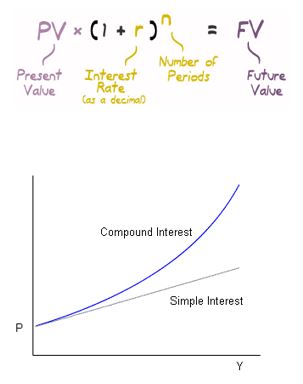
The fascinating thing about compound interest is it may take off slowly with humble beginnings, but as you can see from the graph once it gains acceleration it really takes off vertically!
Naturally the banks understand this and use it to their advantage.
So why do I bring this up? Well, when mathematics is involved I find it helps reduce the role of emotions in wealth creation. For a trader who has a consistent winning trading strategy, compounding is a way to build wealth over time.
With the use of directional tools, combined with probability, and the discipline of being consistent with their trading, you can see how building wealth becomes a systematic process rather than an emotional one.
It’s important for traders to realise that modest and consistent results over time can really add up.
GOAL SETTING
For a trader starting out it is important for them to simply focus on getting consistent winning trades, using safety 1, 2, 3, at all times. This builds confidence. Trading on a small account size while they gain experience can be very beneficial. Hopefully with experience, the account grows. And then armed with the experience of trading they can handle an account size with a few more zeroes on it.
Mindset is the key. I have found this affirmation by Mark Douglas (Trading in the Zone) of enormous benefit, “I am a consistently successful trader!”
It is absolute paramount to protect mindset! And while trading maintain awareness of the market’s greed and fear, and how those emotions will often come up. Staying in a state of balance is important.
 A trader, once they have a winning system going, will find that focussing on fine tuning their skill leads to new stages of development.
Again, a trader needs to be specific with time frames when it comes to planning their growth. It is not helpful for them to say, ‘I will be a good trader in 18 months’ time.’ It is better they say, ‘I will train with an account size of $10,000 to begin with. After 6 months, if my consistency grows, I will add another $5,000, trade consistently, and in 18 months, after more consistent results, I will add “X” amount of further capital.’
You can see how this is thought out better, planned, strategic, specific, measurable, and more likely to be accomplished.
In the early stages a mentor wants to see their student make consistent and steady small winning trades to build their confidence. Protecting their confidence and mindset is the key!
PLANNING GROWTH IN TRADING & INVESTING
I’ve noticed that in life there is nothing like experience. Isn’t it phenomenal when you watch an athlete, musician, or performer, make something look extremely easy? I’ve concluded you are in the presence of a master when they make something look as effortless as if anyone could do it. That’s when the hours of practice and experience pay off. Trading is a ‘trade’. Yes, there’s a certain amount of talent involved, but discipline must follow. It takes time to learn, practice and master; and for those starting out it is important for them to recognise they need to serve their apprenticeship. After this they can add their own flavour and what works for them to their strategy, while on their way to master status as they begin to ‘flow’.
For any new trader it’s key to remember unless they are in the ‘big time’, that is a ‘market maker’ they should approach the markets more like a surfer. They don’t control the wave and its swell. How they ride the wave of the markets though will be instrumental in determining their success. At all times they need to avoid a wipe out! Protect and preserve capital when taking a loss or cutting them quickly is critical.
Recognising there are stages in the journey is important. We all take a journey from babyhood, toddlers, children, teenagers, young adults, to grown professionals in our fields. It was a process to learn our area of expertise. Trading is, too. Its growth happens in stages which is different for every individual. Trading hits difficult times and is not always easy. The problem is the growth stops when someone gives up and quits.
 Below are the steps traders go through to learn their craft:
- 1. Starting – Keeping it simple and learning the way the trading game operates, its rules and anomalies.
- 2. Baby step experience – Generally, this is where the trader is following exactly what their mentor showed them to do. They follow it step by step continually referring to them for guidance. They’re always strictly sticking to the rules/guidelines that have been written by their teacher or mentor.
- 3. Growth – There’s a growth in confidence. The trader is adding their own flare, systemising what works for them, while sticking closely to the guidelines.
- 4. Trial and error – There is growth in confidence. And experience of what does and doesn’t work is being gained.
- 5. Mastery – Where instinct and experience combine where they know back-to-front the essential structure of their trading, and can combine 4 or 5 strategies or moves to get the results they require.
Mark Douglas in “Trading in the Zone” writes them as 3 stages:
- 1. Mechanical – following a system
- 2. Subjective – based on what you know you will respond. You need to be aware of errors that you will make.
- 3. Mastery – use of intuition
I come back to what my first mentor taught me in my first lesson. ‘If you can learn to take a loss you’ll know how to win.’
I’ve always found it helpful in trading that if it doesn’t go your way, always be quick to cut your losses and move on! Stop the haemorrhaging! Protect your wealth!
Once a loss is taken, it clears a trader’s mind to now be free to look for another winning trade, rather than their mind always being concerned about what they should do to ‘avoid’ a loss.
Here are a number of questions a trader should ask themselves in helping them plan their growth to the next level?
How do I …
- Get more experience?
- Get more capital?
- Get more structure in place?
- Get better systems?
- Get better backup systems?
- Get trading buddies or get involved in a team?
- Do I need to change my lifestyle?
- What do I have to do to handle my emotions better?
- What do I need to learn or find someone to teach me?
Each of these questions, if carefully planned, and meticulously answered, and then actioned, can help traders grow in their craft.
In any goal setting it is crucial that a person is clear on what they want, and how they plan to achieve it.
You have to recognise you are always learning. While options’ trading is my passion I discover new things about it continually. In fact, the more I learn the more I realise I don’t know.
There are always numerous different options strategies. Yet within that wonderment of discovering something new, there lies the need to stay focussed on what works.
 Balance is the key. Here is what is essential for traders to be disciplined in:
- Developing their strategy & systems
- Sticking to their strategy once it is proven to work
- Growing in their experience
- Flowing and growing with experience
- Recognising the stages of growth & learning
- Planning their growth in trading, investing, and business
- Be intentional in actions
Trading is an art form. It is sometimes difficult. Having said this, I find it fascinating that so often we put limitations on ourselves. ‘I can do this, but I can’t …’
If it is scientifically proven that the universe is continually expanding, why do we put limitations on what we can achieve?
Thank you!
We trust you have enjoyed the Advanced Options Trading Course 101 – Introductory Course and how it has added to your professional development.
Please be aware that Trading Institute and Mentor Education also offer the 12 Month Premium Classroom – Advanced Options Trading Course 201
This is the premium package where you get 12 months live teaching with one of our facilitators, one-on-one time with them and classroom teaching.
✓ Weekly hour class with limited webinar class size to ensure premium value
✓ 12 month exposures to different cycles of the market
✓ Greater focus on strategies, especially the ones personally used by founder Derek Whitaker, combining directional with probability trading which can be applied in any market. Observe how money can potentially be made in bullish, bearish and flat markets, while always protecting a trade in case it turns against a trader.
✓ Greater focus on mindset and understanding how a trader thinks in searching for trades, handling trades, and account management
✓ Case studies of actual and virtual trades performed by class facilitator and students.
✓ One-on-one access to your class facilitator to ensure any queries you have are covered
✓ Advanced strategies in defending trading accounts
✓ Exclusive access to class recordings to review lessons in your own time
✓ Opportunity in class room setting to learn from your colleagues, while case studying and workshopping your own virtual trades
✓ Paced learning
✓ Ability to access class anywhere in the world provided you have a good internet connection. Perfect for overseas travel or even FIFO (Fly-in-fly out workers)
✓ Opportunity for ongoing professional development to the Alumni access
Format: Online webinar with a 12 month commitment
(Students must apply for enrolment for this course. Not all applications are guaranteed acceptance.)
For more on this simply call Mentor Education on 1300 054 253 (Australia Callers)
+61 3 8317 2900 (Overseas Callers)
REFERENCES
Quoteinvestigator.com
Torah