

GETTING ORGAINZED FOR OPPORTUNITIES
Consulting in the financial industry allows you to see what does and doesn’t work when it comes to wealth creation. You get to hear people’s stories, what they did or didn’t do, and compare it to the results of those actions, and you learn from their successes and mistakes.
 I’ve heard many success and failure stories. I’ve seen errors such as people financially supporting their businesses far too long, rather than their businesses supporting them, due to their emotional attachment to their company. I’ve seen those who greatly benefited by having structured their businesses correctly with brilliant asset protection and tax minimisation strategies, making their finances untouchable when a law suit comes along.
Additionally, I have noticed that certain people who have worked in particular industries have mindset benefits that are lacking in the rest of the general population.
For instance, those who have worked in the military often have a mindset that is set apart from the everyday mum-and-dad investor. Very often their military training is very good for business, and particularly trading. Their mindset pushes them through pain, they understand to have success they must have very clear focus, and generally show incredible organisational skills when it comes to having their finances and business in order.
 I’ve also admired the organisational prowess of project managers, and the processes engineers employ to get results.
Having said this, strengths can also have weaknesses associated with it. For instance, I have noticed while engineers are incredibly gifted in problem solving their weakness can be they that over analyse things, procrastinate, and don’t take action simply because they don’t understand everything. For example, I remember one engineer who needed a trust set up and because he did not fully understand all the very technical legalities behind it, refused to proceed. After going through it with him for quite some time I eventually told him that I had got in a car and driven to the office that day and even though I don’t profess to understand all the mechanics of how the vehicle got me there I just know it worked, and it got me the results I needed. Then I went over again the key benefits of a trust – asset protection and the ability to minimise tax. That’s it! The benefits were simple and in my mind I was saying,
‘There is no need to over complicate it!’ However, he insisted on understanding the legal ramifications of how the trustee related to the trust, and after going through it all with him again I soon realised he was never going to progress to the next stage of actually actioning it.
Creative people have a tendency to lose focus. I confess this is one of my weaknesses. We discover something new, love that ‘wow’ factor, and can do amazing things in expressing it to others. But soon we can get bored with it, and instead of persisting with it can tend to move on to try and discover the next ‘wow’. This can be a danger when trading if they don’t stay disciplined to persist with their strategy and system that works even when it becomes easy and/or ‘boring’. In fact, in some ways ‘boring’ is the goal of trading. It eradicates any gambling tendencies for a trader.
Additionally, I have noticed over the years those who have great clarity on their goals generally have greater success on their finances. Half the battle is defining what you want out of life, and this is why we spent a great deal of time at the start of this course on mindset, and life purpose.
Working in an accounting and law firm I’ve also observed that a regulator often is impressed in an audit if the individual being audited is organised. It goes in the individual’s favour. They can easily present requested information and account for actions taken.
Thirdly, those who are organised have increased the probability of building wealth.
 They are able to trace in detail where their money is going, where any leakages might be, and what can be done to remedy the situation if required. I remember one soldier sent me a excel sheet in their tax returns submission itemising her annual expenditure in precise detail including shaded pie graphs for every area. At a glance I could see where her finances were going, and what fascinated me was without knowing her very well I was able to identify her values immediately. Where you spend your time and money is where your values lie. Health was very important to her as it was in the top 2 areas of expenditure.
The more trading is organised like a business, the easier it is for the trader to trace what is working and what isn’t. They are able to plan their progress, growth, and hold themselves accountable for their own trades. They can see which strategies are working, identify which stock works best for them, and which ones don’t. They can track what actions worked in different markets, and are far more on their toes and geared for success.
I’ve seen an engineer go into precise detail as to how he would grow his trading account and incorporate this as one of the key areas for his wealth creation as his skill increases. It was specific, it was well thought out, planned, and best of all actioned! I learned a lot simply observing his precision.
It’s one thing to dream, it’s another thing to plan, and it’s an entirely different step to then action it. Self-doubt is one of the greatest saboteurs of success. It can rob an individual of their dream.
Additionally, it’s often said in our industry that one of the greatest reasons that businesses fail is simply because people give up. It gets too hard, and too painful. I like the motivational line I read recently that was referring to exercise. ‘You can either skip pain now and experience it later in life, or you can embrace it now and reap its benefits later in life.’
Tony Robbins reasons we humans are motivated by pain and pleasure. We avoid the pain and gravitate towards pleasure. For example, our natural inclinations to eat certain foods which aren’t necessarily for our long term benefit or our negative view to exercise are pain avoidance behaviours. What often has to be redefined is what will hurt the most? Or how can I associate a painful experience to a pleasurable one? For example, the individual who finds saving painful might need to realign their definition by realising saving may lead to investing which could lead to more wealth which is ‘pleasure.’
Running your own business, just like trading, requires a high level of self-discipline to stick to your goals, be flexible enough to adjust your game plan if required to attain them, and simply keep persisting to see things come to completion. To be able to create great processes to leverage your time, while knowing how to market your business from beginning to end, and creating a great customers experience is paramount. This is why business plans are often worked on in great detail.
 Further, this is why we highly endorse running your trading like a business. When set up this way, it increases the probability of success for a trader.
Goal setting leads to strategy, which leads to defined time frames. People who do this with their finances increase their probability of success. It is the same for those wanting to trade.
When a trader is organised they are set up better for opportunities when they present. The trader knows precisely what they are after. This has been defined, the intent is focussed. If the trade doesn’t meet their criteria they quickly move on. If does meet their defined guidelines, they can then assess the merit of the trade. How strong is it? What are its risk vs rewards? How should it be now handled?
A business has a defined process to get a result, and so should trading!
So where does a trader start in getting organised?
Well let’s assume that the trader has already defined their strategy, their trading guidelines and criteria, and how they identify the underlying stocks suitable for them to trade. The next step is setting up a watch list.
I personally have a few areas where I can refer to my watch list. They are obviously on my trading platform area, they can appear on the stock platforms I monitor when the market is live which are independent of my broker, and they appear in a couple of apps on my smart phone. I also have the broker’s app on my phone ready to activate ‘just in case’.
In the previous class I mentioned a trader will often then check the charts for an opportunity to trade using their indicators.
Then there’s the process of checking for profitability of the trade while comparing it to the risks.
And this is where the next stage of preparation comes in – creating a list of tiers using beta.
COMBINING WATCH LISTS WITH BETA
You’ll recall that beta is an indicator that compares a particular stock to the market whole. The market index such as the S&P 500 is given the numerical value of 1. Every other stock is measured against this when we refer to beta. If a stock appears above 1 it is more volatile than the market. If it is below 1 it is less volatile than the market whole.
From here a trader can begin to form a watch list with tiers that define the volatility of the stocks that appear in their watch list.
Why is this important?
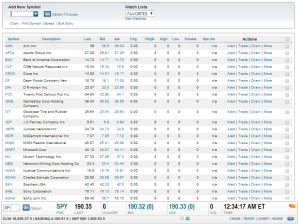 Well, identifying how volatile a stock trades in your watch list is prudent for a trader in understanding their selected portfolio.
If a trader is trying to create a balanced portfolio they have a method that helps them define how stocks should be traded in relation to their volatility. It also begins to define how a trader will treat that stock when it comes to buying and selling options over them.
For example some stock will be treated with more caution than others. A trader can begin to define how close to the money they will trade a specific stock in the watch list and how much buffer between the stock price and sold legs is required, especially when it involves spreads.
Additionally, when it comes to spreads there is the need to define how many strikes there will be between the bought and sold legs of a trade. They could be as low as $0.50 through to several dollars depending on the strike gaps of the stock. (A stock trading at $500 will have $5 strike gaps for instance.) Let’s assume for the most part stocks are traded in $1 increments, and for these traders can define how many dollars strikes there will be between the sold and bought legs.
This process is further defining the treatment of specific individual stock within the guidelines of a trader’s overall options strategy – whether that be covered calls, spreads etc.
DEFINING STRIKE GAPS AND BUFFER
One trader I know once showed me how they break up their stocks into specific areas utilising beta.
In his system there are 3 tiers. The higher the tier the more volatile the stock is, the higher their beta. There are 14 stocks he trades options over on the ASX and he has ranked each of them.
He trades a form of straddle which is a reverse spread ratio. And there are two things that are adjusted in each tier in relation to volatility and beta:
- 1. The buffers between where he places the strike price of his trade compared to the stock price vary in each tier. (E.g. I personally place a minimal 10% buffer between where the stock is trading in the market and where I place a sold liability.)
- 2. The strike gaps between the bought and sold leg vary between tiers.
Remember the higher the volatility the greater the premiums. This means there are opportunities to adjust the buffer and strike gaps according to the premiums on offer. When there are higher option prices there is greater flexibility.
Tier 1
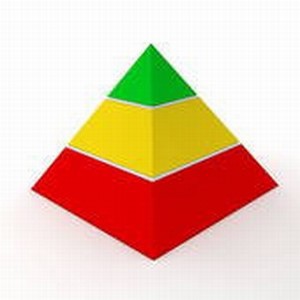 In tier 1 he insists on the highest level of protection. He will put in the most strike gaps over these stocks compared to his other categories to ensure they have higher protection. The strike gaps are specifically defined to the dollar amount, and he has one stock that is double what the others are in this category to compensate for its extreme volatility. There are three stocks that fit this category for him, and they are all mining stocks. He has defined specifically how far from the money he will trade, and specific strike gaps between the legs to defend them as required.
Tier 2
In his Tier 2 category he requires less protection compared to Tier 1. His buffers between the options strike point and where the stock is trading at is less. His straddle legs are less conservative, but allow enough flexibility that if he can get greater buffer on where he can place his strike points between the bought and sold legs he can. He has 5 stocks in this area which are a combination of mining, banking, retail and agricultural stock.
Tier 3
In his final category we find the least volatile stocks that he trades. There is less buffer in his strike gaps while allowing him to have some flexibility if the market presents it. Six of his stocks fall here. They are mostly bank stocks with one index.
What you must realise is nothing is set in concrete. Some of these stocks may change in their tier categories. They may begin conservative and become more aggressive, etc. However, it is a reference point for the various beta trades where he’s specifically defined buffer between the strikes and the stock price, and even defined the strike gaps between the various legs of the straddles he trades.
The various stocks may move and a trader must be able to adjust. For example, some months they may have 6 stocks in tier 2 which might need to be changed if the behaviour of the stock changes. Flexibility is the key.
Game plans can be tweaked, but the general principles of the strategy stay intact.