

Disclaimer: Before you start, we need to tell you upfront we are not a licensed financial planning firm. We are simply an education company, who will give you factual information. We do not give any general or specific advice around options, trading, or anything else. That is not what this course does. Please see a licensed financial planner when it comes to any investment advice you need. The purpose of this article is to report on various strategies and techniques observed by other traders in the use of this particular strategy. It is not a recommendation and this information must be handled responsibly. Any personal preferences offered by the author are intended to demonstrate to the reader how they think in analysing options strategies. They are not a recommendation to trade or not to trade.
Covered calls are the most commonly known strategy when it comes to options trading. This is probably because they are easy to understand especially for those who are or have been stock buyers.
WHAT IS A COVERED CALL?
 A covered call is where the trader buys the stock and sells a call option over that stock, giving the purchaser the right to buy that stock from them should it reach the agreed strike point. This is sometimes referred to as a “buy-write” or some have colloquially called it “share renting”.
Share renting is a metaphor on how the strategy works. Most people understand what happens when you rent out a house. You own the house. You have a tenant renting it from you. You profit from the rental return and from any capital growth. This is similar to a covered call.
However, when it comes to a covered call any capital growth of a share is actually capped.
If the price of the house drops the owner still owns the house even if there is a loss in value. And naturally it is the same with direct shares ownership. If they drop you are left with the difference between what you originally purchased them for and what they are worth now.
Just as you can insure a house so you can metaphorically “insure” stock by buying protective puts.
You can insure a house against damage and theft but what owners don’t generally insure a house against is loss of capital growth. However, here’s the big difference, in the share market you can insure some stocks against loss in capital value.
Here’s how a covered call plays out …
The trader may own the stock or buys them. Often in the same transaction they will also sell a call option for that month over the same stock at a price either at-the-money, out-of-the money depending on profitability. (Additionally some traders will place the call option in-the-money if the numbers stack up. Understand each strategy and trader often has slight variations to the general principle.)
So take this example … (For the sake of simplicity, in these samples we are not considering brokerage costs in any of the transactions.)
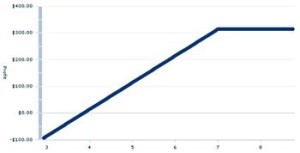 Mary sees that ABC shares are trading on the US markets at $20.65. She decides to place a “buy write” trade and over 3 contracts. (In other words she is buying the shares and selling calls over the underlying at the same time.)
The outlay for the shares would be $20.65 x 100 x 3 = $6,195.
Now to ‘rent’ these out Mary decides to sell an out-of-money call option at $21 and gets $0.45 for the contract.
So the ‘rent’ Mary would receive is: $0.45 x 100 x 3 = $135.
This is a 2% return on investment (ROI) on the $6,195 outlay for an out-of-the money call option.
ROI = $135 call premium / $6,195 outlay of stock x 100 (percent) = 2.18%
So this is the basis on entering the trade. Now knowing the market can move in only 3 directions let’s explore how this may play out in each scenario …
Covered call in a bull market. (The stock is going up.)
ABC shares go to $22.
In this situation the person who bought the call would take the stock out of Mary’s account. That is she would be exercised. Remember by selling the call Mary has said to the market, “this contract gives you the right, but not the obligation, to purchase this stock at $21, no matter how high or low this stock goes within this time frame.
Mary keeps the $135 upfront payment.
For this the part of the transaction Mary is paid is $21.00 + 0.45 = $21.45.
However, she also had a capital growth of $0.35. (Remember the original purchase price was $20.65, and she sold a call option at $21.00.) She doesn’t get the extra $1 for the growth to $22 due to the call she sold at the strike price of $21.
So Mary’s total profit for the covered call is calculated as:
Stock growth (which is calculated as call strike price sold minus original purchase price of stock) + option premium
Stock growth = ($21 – $20.65) + $0.45 = $0.80
So in converting that to 3 contracts in the trade $0.80 x 100 contracts x 3 contracts = $240
Total profit = $240.
Is this a good result? Some may argue she missed out on greater profit. A trader’s mindset is it’s a great result. When you consider what was achieved in a month this is a good return on investment. A trader should never complain about a profit.
Covered call in a flat market
Let’s see how the same transaction plays out in a flat market.
ABC shares were bought at $20.65.
At the end of the month the shares are now worth $20.80.
The result is Mary keeps the premium of $135.
She also keeps the shares now worth $20.80 x 100 x 3 = $6,240. (It is not profitable for the person who bought the call to exercise the right at $21 when the market value for the shares is only $20.80. They’d be paying too much.)
Mary’s stock capital is now worth $6,375 and she’s made $135 for the call options. So her total profit is now = $6,135.
Is this a good result? From a trading perspective, yes! She’s had more income for the month than she would have had plus capital growth.
Covered call in a bear market (falling)
Let’s look at what happens to a covered call in a bear market …
ABC shares were bought at $20.65
At the end of the month they are now worth $19.00.
Mary keeps the premium of $135.
She still has the shares at the end of the month.
They are now worth $19.00 x 100 x 3 = $5,700.
This means the total account value is now $5,700 + $135 = $5,835.
Is this a good result? Well, she has a loss now simply because the stock dropped. The call premium was received and kept, but there was a loss in capital when it comes to the lower stock value.
So we see the covered call fairs well in a bullish, and fairly well in a flat market. It didn’t do so well in a bearish market. Let’s extend the scenario now to the following month as to what Mary’s options might be.
Bull market
What actions could she take if she were exercised?
She’s experienced a winning trade. The bull market on a covered call ensured she kept her sold call premium, and the stock has been taken by the buyer from her account. She would probably look for another winning trade.
Flat market
What actions would she take if it was a flat market?
The stock has not been exercised and remains in her account, and she has profited from the options premium.
Well, she could either sell the stock if it is above her purchase price. If it is less she may still be ahead with the option call she sold.
She could also sell another call over the same stock maintaining the same contract size and collect more premiums from the sale.
In other words she has the choice to repeat the exercise or sell the stock.
Bear market
What actions could she take if it was a bear market? I.e. The stock drops in value, and she keeps the options premium.
Well, the scenario here is her capital is threatened. A trader must at all times protect their capital!
HOW DO YOU PROTECT A COVERED CALL?
There are a couple of ways a covered call trade can be protected in a bear market.
Consider this strategy …
Covered call with protective put (or collar)
What would happen if in addition to the bought stock and sold call, Mary also bought a put to protect or “insure” the stock?
 ‘Now the key here is to ensure it would be profitable to do so, otherwise there’s no point to the exercise. An at-the-money put is likely to cost too much when you consider the premium she is receiving on the out-of-the money call. You’d have to do the figures, but she could possibly buy a put at a lower strike price.
The premium for the put has to remain much lower than the premium for the call in order for the trade to stay profitable.
Strategically this way her capital is protected and she is receiving a premium at the same time. The down side is her profit would be reduced. The protective put bought in this instance is sometimes referred to as a “collar”. It technically is at the same strike distance the out-of-the-money sold call is to the stock, and over the same amount of contracts.
So how does this play out mathematically?
ABC shares are trading at $20.65.
Mary might buy 3 contracts of ABC stock.
Outlay would be $20.65 x 100 x 3 = $6,195.
Now to ‘rent’ these out she may sell a call option out of the money at $21 and get 0.45 for the contract.
So the ‘rent’ she would receive is: $0.45 x 100 x 3 = $135.
This is a 2% return on the $6,195 outlay for an out-of-the money call option.
To protect the stock from falling she might buy a cheap put at $19 strike price for $0.15.
The profit is now calculated as …
Call option premium subtract put option premium
$0.45 – $0.15 = $0.30
That’s $0.30 x 100 x 3 = $90 profit instead of the original $135.
Now the trade to start with is a 1.4% return on investment.
$90 / $6,195 = 0.014 x 100 = 1.4%
Is this a good result? Well, yes when you consider the time it has taken to do the trade.
What happens if the stock continues to go bearish?
Let’s walk through it again.
ABC stock ends up going to $18.90.
Mary would keep the call premium. She would lose value on her original stock price BUT she insured it at $19!
Stock price of $19 – Original price $20.65 + call option of 0.45 – put purchase of $0.15 = -$1.35
Is that a good result? Well, it’s not as good as a winning trade, and you have to expect that losing trades are part of the game. However, Mary capped her losses as well as her profits and in this instance if she hadn’t, her loss would have been far greater.
What if she didn’t write a collar and the stock ended up going to $18.90?
Instead of waiting to the end of the month she could keep a good portion of the original call and BUY TO CLOSE (BTC) the call option. It would now be significantly cheaper because of the loss in intrinsic and time value. Remember as options move from at-the-money to out-of-the money they lose significant value.
Then she MAY consider writing a call option at a new strike price of perhaps $19 for the current or following month depending on how long it is until expiry and the premium she would get for both scenarios.
If it was close to expiry for the current month the premium for the following would be higher due to the time value of the option.
The action of buying to close (BTC) and then doing a new Sell to Open (STO) for either a position at a new strike price or month to expiry when a trade has gone against you is known as a “roll down”. I often refer to it as a “morph”. It is a defensive strategy when things haven’t gone to plan. In some situations a trader may do it 2-3 times if it continues to go against them, in an effort to protect their capital before accepting a loss.
Mary may also consider a collar for the following month if she was concerned the stock may continue on its downward trend. This way the capital loss has been reduced.
Other covered call traders have told me that in an incredibly bearish market they may hold onto the stock while protecting it with a put without immediately selling an at-the-money call at the new lower strike price. They prefer to sit tight rather than risk losing on their stock by selling it at a lesser strike price. If the stock does recover they would be exercised in a call at a price lower than they originally bought the stock for. They want to allow the stock time to recover so a protective put can be put in to mitigate any further loss, while waiting to see if the stock will bounce back and recover.
Another scenario some covered call traders could consider would be to sell an option the following month at what the original strike price was when they entered. Some call this “going further out”. They are ensuring if the stock does recover so do their capital returns to the original levels, and they receive some premium to go toward the cost of buying a protective put. Again this all depends on premium costs relative to how far the underlying stock has fallen. (Remember the further the underlying moves away from an out-of-money option the further it falls in value.) Each scenario has to be assessed by a trader as they trade.
The key here for a trader is they ALWAYS need to protect capital when it goes against them!
For those who have only traded stock, options begin to open a whole new world of protection and cash flow strategies they usually didn’t know existed!
WHAT ARE THE PROS AND CONS OF A COVERED CALL STRATEGY?
There are always pros and cons for every strategy so let’s start with the positives for the covered call.
For Australian traders covered calls are one of the few trade strategies that are currently allowed by the ATO for Self Managed Super Funds (SMSF) provided they are done without margin, and subject to the SMSF trust deed allowing them to trade options. Stocks are allowed in a SMSF but trading strategies involving margin aren’t. So some traders like this strategy for their retirement funds and the tax breaks on profits associated with SMSF’s.
Secondly, covered calls are profitable in a bull and flat market. A trader owns the stock at the beginning so any downturn has some safety in it.
 Thirdly covered calls may work for a trader who wants to hang onto their stock in a flat market. Now picking the precise highs and lows of a stock is impossible. However, if they pick a price point at which they are prepared to pay for the stock, writing calls over it may be a way to experience cash flow while allowing for some capital growth. If the stock doesn’t reach that price point, they have created income they otherwise would not have had.
Covered calls MAY be a strategy for someone who doesn’t want to part with their stock in a privatised company which is starting to go public and be floated on an exchange. Particularly if that individual considers the stock to be a good investment for the future and expects further growth, a covered call strategy may be a cash flow strategy they utilise provided they know that they can be exercised if the call they sell goes in-the-money.
Covered calls MAY also suit someone who wants to sell their shares but wants a bit more for them than if they sold them at current market value. They may want to allow for a bit more capital growth and receive a premium from the call sale, allowing the buyer to take them from them.
A final positive for covered calls is they can be protected by a collar (protective put) however; this will reduce profitability in the case of a winning trade.
When consulting I have observed some people have traded this strategy with great success.
The downside for covered calls is in a bearish market if a protective put isn’t in place the original capital of the stock is not protected, and the trader can suffer loss. This would be the same for a stockholder, and in some instances the stock trader is worse off if they held onto the stock as they have not sold a call to offset some of the loss.
The second negative on this strategy is covered calls take up a lot of a trader’s capital as you must own the stock to write a call over it. Tied up capital restricts how many trades a trader can make within a given month.
Thirdly, covered calls mean the stock is subject to price fluctuations in the market. Personally I prefer to sit on the sidelines in out-of-the money positions. (Again, this is not advice just a personal report on my preference.)
The key to remember for a covered call trader is that stocks can always be sold and then bought back again. Too often people become infatuated with their stock and don’t want to risk “losing” them. They fall into the mindset of “wanting to own a piece of the company”. For a trader capital must always be protected and “trading” them back and forth is part of their strategy. They are not out to build a “portfolio”. They are there to increase their account capital by placing themselves in profitable positions in flow with market movements.
References:
OptionsXpress – Covered Call diagram